
a terminal you
leave open.
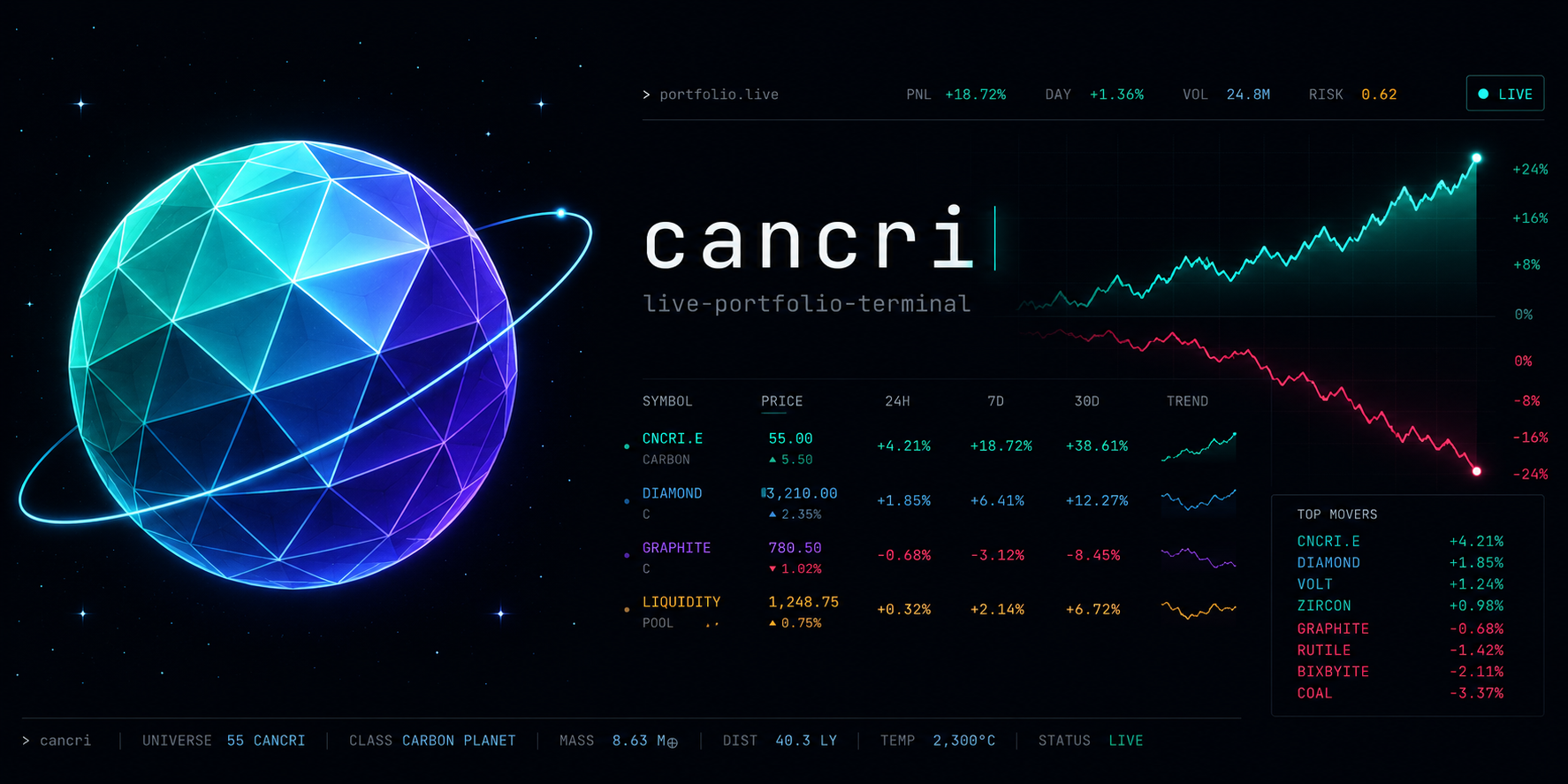
cancri is an access-gated, real-time web terminal that streams your own portfolio at cent-level latency. colour and motion carry information — direction, freshness, activity — never decoration. and the terminal always tells the truth about its own data: LIVE vs DELAYED is never hidden.
read-only · per-user · onboarding via Gemini · self-healing data layer that opens a PR, never auto-merges.
start here
Quickstart
One command, one container, zero secrets. Boot the terminal locally against a mock feed in under a minute.
↳ quickstart 02 — use itUsage
Describe your holdings, let Gemini propose an inventory, confirm it, and read the live dashboard.
↳ usage 03 — contributeContributing
Dev loop, tests, the smADR ritual, and the conventions that keep the terminal honest.
↳ contributingWhat it is
You describe your holdings in plain language (or drop a CSV / Excel), an LLM normalises them into a confirmed inventory, and a live data layer keeps the numbers moving — flashing mint up, rose down, with a sparkline that draws itself on every tick. It is read-only: no orders, no trading. Just the truth about your book, beautifully.
the machine proposes — you dispose. Nothing streams until you confirm your inventory. And the self-healing data layer opens a pull request when the upstream protocol changes — it never merges itself.
The principles
| principle | what it means |
|---|---|
| colour = meaning | up is ▲ + in mint, down is ▼ − in rose. Direction is never colour-only. |
| freshness is honest | LIVE (mint, calm breathing pulse) vs DELAYED (amber, off-beat) — by colour and rhythm and text. |
| honesty over blackout | when the primary feed dies, the dashboard doesn't go dark — it flips to the delayed fallback and says so. |
| secrets stay server-side | the client only ever subscribes to normalised ticks. No source internals, no keys. |
| propose, don't dispose | the LLM proposes an inventory; the self-heal proposes a PR. A human always confirms. |
Architecture at a glance
Every architecture decision is recorded as a Structured MADR (ADR-0001 … ADR-0011). The deeper walkthrough lives on the maintaining page.
browser (Firebase Hosting)  vanilla-TS terminal · single rAF loop · subscribes to ticks only
        │ reads /quotes,/feed (RTDB, client read-only)   │ callable · Auth + Firestore (the book)
        ▼                                                ▼
Realtime Database  /quotes/{isin} · /feed/status    Cloud Functions  normalize · confirm · logo (Gemini/Vertex, IAM)
        ▲ sole writer (Admin SDK)
Cloud Run: feed-engine (always-on)  FeedManager · SanityOracle · degradation FSM
        ├─ L&S (primary, real-time · ls-protocol break surface)
        └─ Yahoo (fallback ~15m · also the sanity oracle)
        ▲ when the undocumented L&S protocol changes…
Cloud Run Job: self-heal  Playwright captures frames + rendered price → replay finds the fix → reviewable PR (no auto-merge)
Where to next
- Quickstart — run the terminal locally with one command.
- Usage — onboarding, the dashboard, freshness, and every state.
- Contributing — the dev loop, tests, and the smADR ritual.
- Deploy — ship it to Firebase (CI or one-shot manual).
- Maintaining — architecture, self-heal, CI, and the going-live runway.